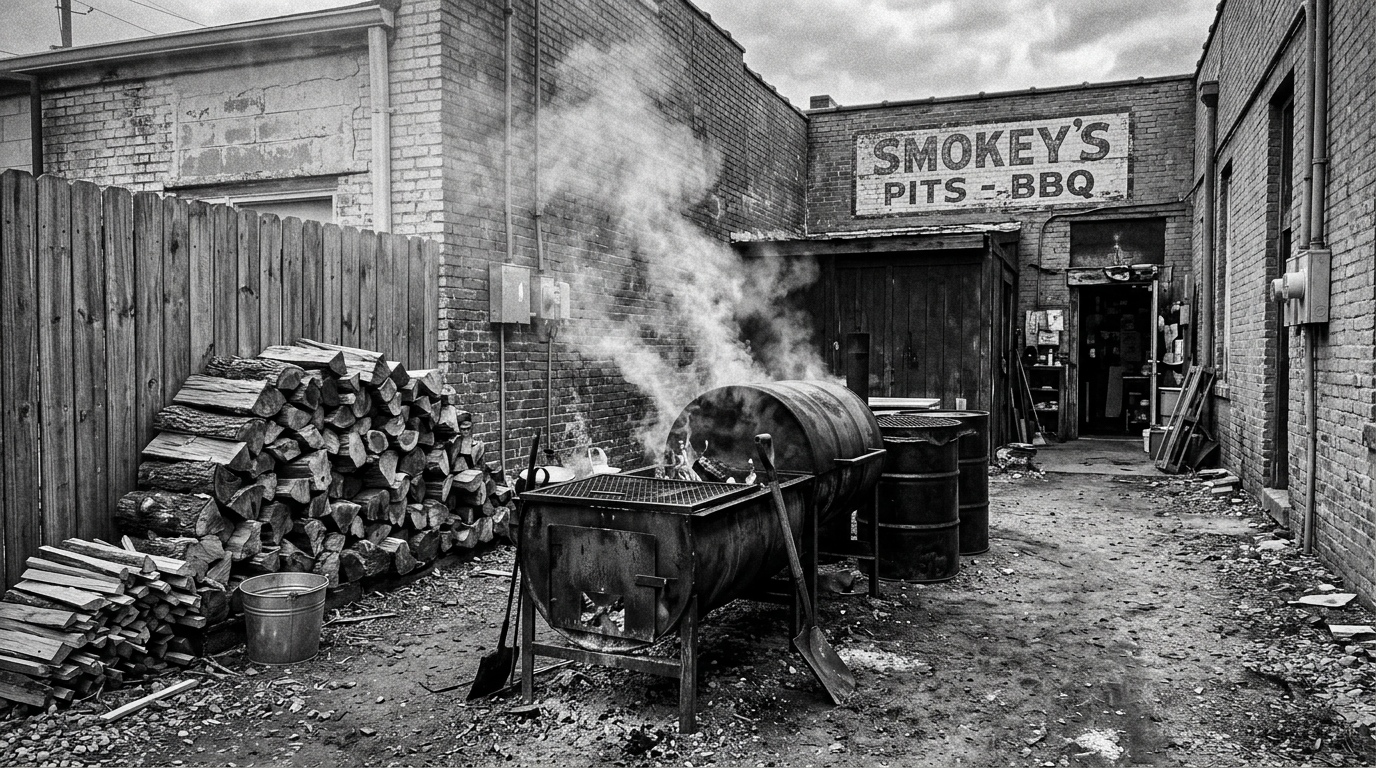
The Smoke that Built a City: A History of Kansas City BBQ
🔥 Big B’s Quick Hits (TL;DR)
- The Founder: Henry Perry, the Father of KC BBQ. He started the whole trade in 1908 from a pushcart in the Garment District.
- The Jazz Scene: The 18th and Vine Jazz scene was fueled by 24-hour BBQ pits during the wide-open Pendergast years.
- The Split: Perry’s legacy split into two distinct paths: the rustic tradition of Arthur Bryant’s and the modern efficiency of Gates Bar-B-Q.
- The Burnt End: These started as free scraps for folks waiting in line. They became a global hit after a 1972 article put them on the map.
- The Regulatory Hub: KC became the world’s BBQ capital by codifying the rules through the founding of the KCBS in 1985.
The Barbecue Capital
When you cross the state line into Kansas City, you aren’t just entering a metro area. You’re entering the thickest BBQ ecosystem on the planet. There are over a hundred smokehouses here. You’ve got everything from century-old grease houses to high-end craft spots. KC holds a title that isn’t just marketing fluff. It really is the Barbecue Capital of the World.
Why here? Why did this patch of the Midwest become the heart of the pitmaster world? It was a perfect storm of geography and industry. Kansas City grew up right where the big stockyards met the railroads. This gave pitmasters access to every kind of meat you can imagine. It also became a home for wood-fired innovation. The Jazz-age speakeasies and the local political machine fueled the fire. This is the story of the smoke that built a city.
Possum Trot and the 1869 Bridge Feast
Long before the first real smokehouse opened, Kansas City was defined by the smell of communal pit fires. In the mid-1800s, the settlement had so much wildlife that leaders almost named it “Possum Trot.” They eventually settled on the Town of Kansas, but that abundance of small game—raccoons, possums, and rabbits—was the foundation for the city’s earliest wood-fired menus.
The first big milestone happened on July 3, 1869. The city was celebrating the Hannibal Bridge, the first permanent rail crossing over the Missouri River. They threw a massive communal barbecue that served thousands of people. This wasn’t a modern low and slow affair. It was a wild open-pit celebration. It proved KC had the appetite to handle big wood-fired cooking. It set the stage for the industrial meatpacking boom that turned the city into a global protein center.
The Caribbean Roots: From Barbacoa to the Midwest
We often think of BBQ as a uniquely American invention. In reality, the technical roots are much older and reach much further south. The word ‘barbecue’ traces back to the Caribbean and the Taíno people. They used wooden frames set over fire to slowly cook and preserve meat. They called this practice barabicu. When Spanish explorers documented this technique in the 1500s, they adapted the term into print as barbacoa.
As livestock like pigs and cattle were introduced to North America, these indigenous slow-cooking methods were adapted by African and European settlers. In the American Midwest, the massive hardwood forests along the river valleys provided the perfect fuel. The transition from the Caribbean barabicu to the Kansas City pit was a centuries-long process. It merged indigenous preservation methods with the industrial muscle of the Midwestern stockyards. By the time the 20th century rolled around, KC was perfectly positioned to take these ancient techniques and turn them into a commercial industry.
Henry Perry: The Father of the Pushcart Revolution
Every story has a leader, and for KC BBQ, it is Henry Perry. A migrant from Shelby County near Memphis, Perry spent his early adulthood working as a cook aboard steamboats on the Mississippi and Missouri Rivers. When he settled in Kansas City in 1907, he brought a level of technical skill the city hadn’t seen before.
In 1908, Perry started the city’s commercial barbecue trade. He sold smoked meats from a simple pushcart in an alley at 8th and Banks Street. This was right in the heart of the bustling Garment District. He understood that the local workforce needed fast, high-protein food with a lot of soul. He served hot, slow-smoked meat wrapped in yesterday’s newspaper for just twenty-five cents.
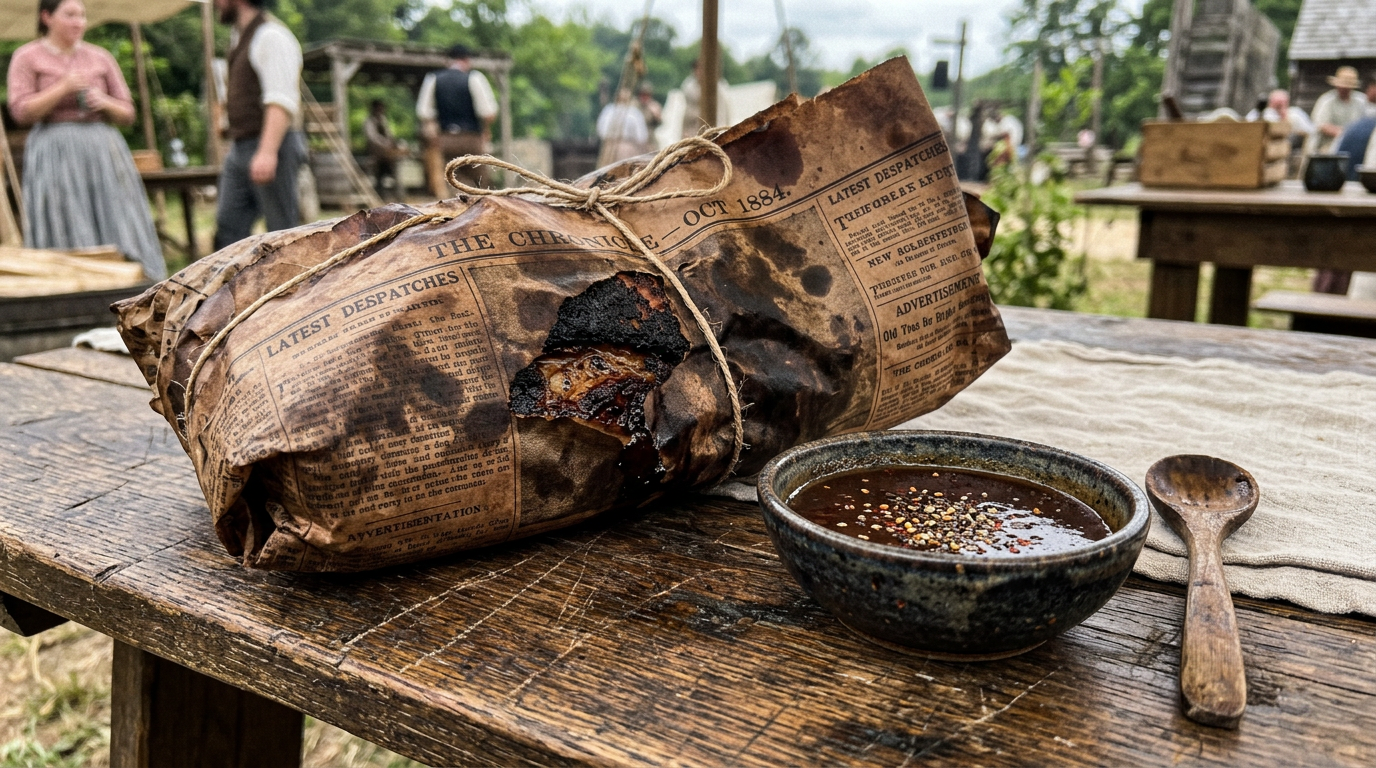
His early menu was a reflection of his rural Southern roots and the ‘Possum Trot’ history of the city. Perry didn’t start with prime brisket. He served smoked possum, woodchuck, raccoon, and rabbit sausage. His original sauce wasn’t sweet. People described it as harsh, thin, and vinegar-based. It relied heavily on cayenne pepper. This was a direct mirror of the traditional Memphis style he grew up with. Perry’s success was foundational. By 1932, the city had over a thousand barbecue stands. All of them were inspired by that one pushcart in an alleyway.
Wide Open Town: Boss Pendergast and the Jazz Era
The real acceleration of Kansas City BBQ culture happened in the 1920s and 30s. This was the era of the political machinery of ‘Boss’ Tom Pendergast. Pendergast ran a ‘wide-open’ city. He ignored federal Prohibition laws and allowed alcohol, nightlife, and culture to flourish without restriction. This unregulated environment built the legendary Kansas City jazz scene centered in the 18th and Vine District.
There was a deep, natural connection between the jazz clubs and the local BBQ pits. The thriving nightlife required constant, affordable food. Musicians who played all-night jam sessions at the Mutual Musicians Foundation would walk out into the dawn air. The aroma of Hickory and oak smoke from nearby pits would draw them in. BBQ wasn’t just a meal. It was the fuel for the music. This connection between jazz and smoke is what permanently linked Kansas City’s signature music with its signature food.
The 18th & Vine District: Bebop and Hickory Smoke
By the mid-1930s, the 18th and Vine District had become one of the most vibrant African American cultural hubs in the nation. It was a place where jazz greats like Count Basie, Charlie Parker, and Ella Fitzgerald created a new sound. They did it in an atmosphere saturated with the scent of wood smoke.
The pits at 18th and Vine were often burning 24 hours a day to keep up with the crowd. The smoke was just a part of the city’s vibe. When you listen to the fast and aggressive nature of Kansas City Jazz, you’re listening to a music that was forged in the same heat as the brisket and ribs. This district is where the ‘Kansas City Style’ was first institutionalized. It moved away from Perry’s Memphis-style harshness. Pitmasters began developing the richer flavor profiles that define the region today.
Municipal Stadium: The Baseball Connection
One of the big technical drivers of KC BBQ’s national fame was the location of Municipal Stadium. It was built in 1923 at 22nd and Brooklyn. The stadium was home to the legendary Kansas City Monarchs of the Negro Leagues. Icons like Satchel Paige and Jackie Robinson played there.
The stadium was just blocks away from the expanding BBQ pits of the Perry lineage. Specifically, it was near the future site of Arthur Bryant’s. The heavy scent of smoked meat routinely drifted over the stadium walls. Visiting athletes and sportswriters became fans of the food. They’d finish a game and walk straight into a local smokehouse. When they traveled to other cities, they didn’t just talk about baseball. They talked about the incredible wood-fired meat they had in Kansas City. This gave KC BBQ a level of national visibility that other regional styles just didn’t have.
The Dynasty Splinter: Bryant vs. Gates
When Henry Perry died in 1940, his legacy didn’t end. It fractured into two distinct paths that still define the city today. This was more than just a change in ownership. It was a divergence in fundamental BBQ philosophy.
Perry’s business went to his longtime employee, Charlie Bryant. Charlie operated the pit until he died. His brother, Arthur Bryant, took control in 1946. Arthur Bryant was a traditionalist. He focused on the ‘grease house’ look. It was rustic, unpretentious, and smoke-stained. At the same time, another Perry apprentice named Arthur Pinkard partnered with George Gates. They started Ol’ Kentucky Bar-B-Q. This eventually became the iconic Gates Bar-B-Q. While the Bryants stuck to the past, the Gates family looked toward the future.
Arthur Bryant’s: The World’s Most Famous Pit
Arthur Bryant moved the family business to a permanent building at 1727 Brooklyn Avenue in 1946. This was right near Municipal Stadium. This move made the restaurant a crossroads for the whole city. It was a place where laborers sat next to mayors. Eventually, U.S. Presidents like Harry S. Truman and Barack Obama came to eat.
Arthur Bryant was a master of adaptation. He changed Henry Perry’s original sauce. He moved away from that harsh Memphis profile. He created a more palatable, tangy, and slightly sweeter sauce. This worked better for a broader commercial audience. He was also a pioneer of high-volume production. He used massive indoor brick pits that could smoke hundreds of briskets and slabs of ribs at the same time. In 1972, a journalist named Calvin Trillin declared Arthur Bryant’s the single best restaurant in the world. That claim changed everything for American BBQ.
Ollie Gates: Engineering the Modern Smokehouse
While Arthur Bryant was keeping the rustic charm of the old pits, Ollie Gates was reinventing the business. Ollie took control of Gates Bar-B-Q in 1960. He had an engineering degree and a background in the U.S. Army. He realized that to survive against modern fast-food chains, BBQ had to become professional.
Ollie Gates walked away from the traditional grease house style. He created standardized recipes to ensure every location tasted the same. This was a new idea in the world of manual wood-fired pits. He required his staff to wear professional uniforms. He built clean, modern dining rooms. He also started aggressive marketing campaigns. He created the iconic Gates logo and the mandatory greeting: “Hi, may I help you?”
This focus on engineering and military precision allowed Gates to grow his business without losing the quality of the smoke. It created a blueprint for how a traditional food culture could survive in a modern economy.
1972: The Moment the Burnt End Was Discovered
The exact technical turning point for KC BBQ’s modern fame was April 1972. Journalist Calvin Trillin published an article in Playboy Magazine. He declared Arthur Bryant’s to be the best restaurant in the world.
Trillin wrote: “The main course at Bryant’s, as far as I am concerned is something that is given away free. It is the burned edges of the brisket. The counterman just pushes them over to the side and anyone who wants them helps himself. I dream of those burned edges.”
At the time, Burnt Ends were literally scrap meat. They were the charred ends of the brisket point muscle that pitmasters couldn’t sell. Trillin’s article created an immediate national demand. Local pitmasters couldn’t keep up. This forced a massive shift. Pitmasters started intentionally smoking brisket points separately and cubing them. This created a high-demand primary product. It was the birth of meat candy and the moment KC BBQ became a global culinary destination.
The Regulatory Capital: Birth of the KCBS
By the mid-1980s, Kansas City was where BBQ was regulated. In 1985, Gary and Carolyn Wells and Rick Welch founded the Kansas City Barbeque Society (KCBS). What started as a local club became the largest competitive BBQ organization in the world.
The KCBS wrote the rules. They established the scoring system for Appearance, Texture, and Taste. These rules now define perfection for over 15,000 members and hundreds of contests globally. Because the organization was born in KC, the Kansas City profile became the international standard. Mahogany barks and sweet/savory balances are now what judges look for everywhere.
Today, the city remains the heart of the competitive world. Every year, the American Royal World Series of Barbecue brings hundreds of teams from all over the globe to the city. The smoke that started with Henry Perry’s pushcart is now a global language. But Kansas City is still the place where the rules are written.
Keep the fire steady and the drinks cold. I’ll see you at the pit.
— Big B