How to Calibrate Your Smoker's Leave-In Temp Probes
Big B’s Quick Hits (TL;DR)
- Probes drift over time: Do not assume a new probe is accurate. Heat, moisture, and bent cables cause them to read off by 5 to 15 degrees.
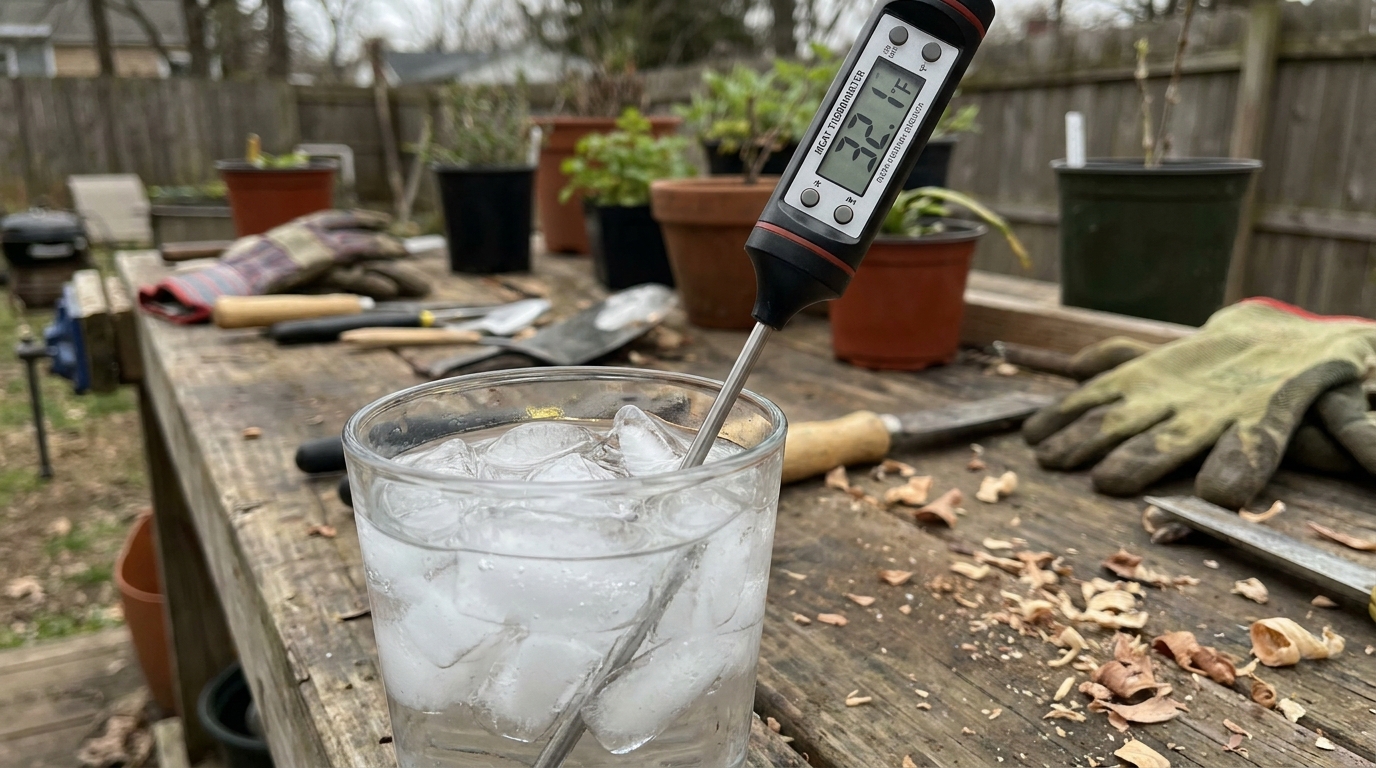
- Use the ice bath first: A thick pack of crushed ice and water gives you a solid 32°F (0°C) baseline.
- Check the boiling point: Boiling water should read 212°F (100°C) at sea level, but adjust for your local elevation if you live up in the hills.
- Set the transmitter offset: Most modern digital transmitters let you save a calibration offset in the settings so you do not have to do math mid-cook.
Introduction
You bought a nice brisket, trimmed it to shape, and set the smoker to 225°F (107°C). You put your trust in a digital transmitter probe, waiting for the magic 203°F (95°C) mark. But when you slice into the flat, it is dry as a boot.
What went wrong? Often, the culprit is not your technique. It is a drifting probe.
Leave-in probes take a beating. They get baked in hot smoke, pinched under heavy steel lids, and splashed with water. Over time, the internal sensors drift. A probe reading 203°F (95°C) might actually be sitting at 188°F (87°C) or 215°F (102°C). To keep your cooks consistent, you need to calibrate your gear at the start of every season, or whenever you suspect the numbers are lying to you.
For the basics on setting up your cook, check out Smoked Brisket 101.
The Danger of a Drifting Probe
The heart of any digital thermometer is a tiny component called a thermistor. This sensor sits in the very tip of the metal probe, measuring temperature by detecting changes in electrical resistance. Because this component is constantly subjected to heat, cold, and smoke, it naturally degrades over time, causing the resistance profile to shift.
For backyard cooks, even a small drift in accuracy can ruin hours of work. If your probe is reading ten degrees too hot, you will pull a packer brisket before it has fully tenderized, leaving you with a tough, chewy flat. Conversely, if the probe reads ten degrees cold, you will keep the meat on the cooker far too long, rendering out all the fat and leaving the meat dry as wood.
Physical damage also plays a massive role in probe drift. Pinching the braided steel cable under a heavy offset lid or getting water inside the crimp junction will alter the electrical signal. Instead of getting a true temperature, your display will jump erratically or show false readings that look correct but are actually off by a mile.
The Ice Water Test (32°F / 0°C)
The ice water test is the standard way to find your low-temperature baseline. At sea level and standard atmospheric pressure, water freezes at exactly 32°F (0°C). By creating a densely packed ice bath, you establish a highly reliable environment that remains stable at freezing point as long as solid ice and liquid water are in equilibrium.
Setting up the ice bath correctly requires a close mix of water and ice. Pack a tall glass to the very top with crushed ice rather than large cubes, as cubes allow pockets of warmer water to form. Pour cold water over the ice until it reaches just below the top of the ice line, stir the mixture thoroughly, and let the slush settle for two minutes so the temperature equalizes.
To run the test, insert the tip of the metal probe into the absolute center of the slushy mixture. Ensure the tip does not touch the bottom or sides of the glass, and keep the crimped wire junction completely dry. Hold the probe steady and watch the transmitter display for about thirty seconds until the digital readout stops moving.
Big B’s Take: If your probe reads between 30°F (-1°C) and 34°F (1°C), it is accurate enough for backyard smoking. However, if the reading falls outside of this narrow window, your probe has drifted and needs an adjustment or a replacement.
The Boiling Water Test (212°F / 100°C)
The boiling water test is your high-temperature checkpoint. At sea level, water boils at exactly 212°F (100°C). Since your finished BBQ targets (like brisket and pork butt) are usually pulled between 195°F (91°C) and 205°F (96°C), having an accurate high-end reading is arguably more important than the freezing-point test.
To set up the test, bring a small pot of clean water to a full, rolling boil on your stove or side burner. Once the bubbles are breaking the surface rapidly, insert the probe tip into the middle of the boiling water. Be careful not to touch the bottom or sides of the pot with the probe, and keep the cable transition joint away from the direct path of rising steam.
Keep in mind that elevation directly affects the boiling point of water. For every 500 feet (152 meters) you live above sea level, the boiling point of water drops by roughly one degree Fahrenheit. If you are cooking in Denver or high up in the hills, make sure to look up your local boiling point before you decide your digital thermometer is faulty.
Setting the Offset or Replacing
Once you know the exact direction and amount of your probe’s temperature drift, you need to manage it. The easiest way is setting a digital offset. Most mid-range to high-end transmitters (like those from ThermoWorks or Inkbird) have a built-in calibration setting where you can input a manual adjustment value (like +3 degrees or -2 degrees) so the transmitter display matches the true temperature.
If your transmitter is a budget model without a calibration menu, you will have to rely on backyard math. If your probe reads 4 degrees hot at the boiling point, you must pull your brisket when the display shows 207°F (97°C) instead of your standard 203°F (95°C). Write this offset on a piece of painter’s tape and stick it to the transmitter shell so you do not forget the math when you are tired in the middle of a cook.
If your probe is off by more than 15 degrees, or if the temperature readings on the display screen jump around erratically, the internal sensor is shot. This usually means that moisture has gotten past the metal crimp and into the wire insulation. Toss the broken probe in the trash and buy a fresh replacement, making sure to handle the new cable with care.
Keep the fire steady and the drinks cold. I’ll see you at the pit. - Big B