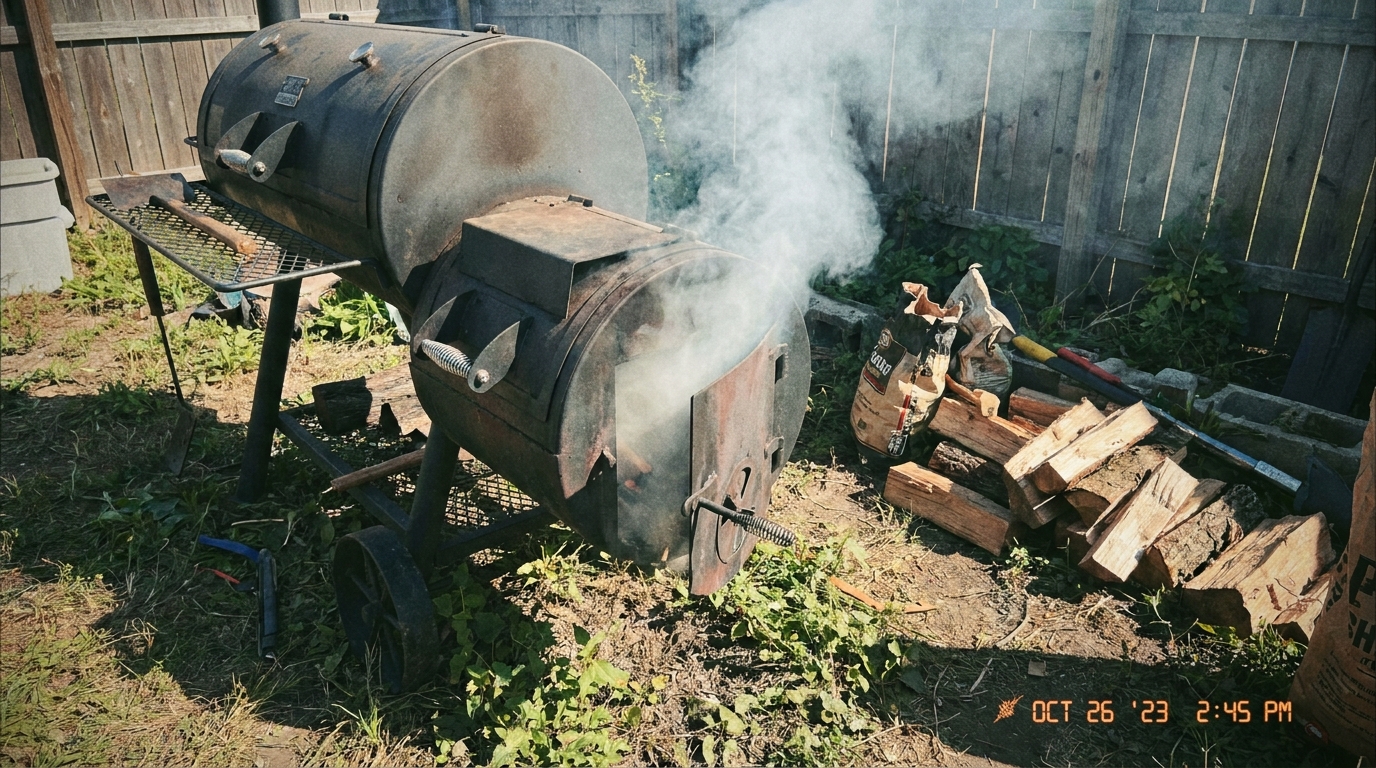
Fixing Dirty Smoke on Your Offset Smoker
Big B’s Quick Hits (TL;DR)
- Read the stack, not the door: Thick white or grey smoke at the chimney means dirty smoke. Fix it before the meat soaks up creosote.
- Airflow first: Keep the chimney wide open. Control heat with fire size, not by choking vents.
- Dry, preheated wood: Cold or wet splits smolder. Warm them on the firebox before you toss them in.
- Mid-cook reset: If smoke stays dirty for 15 minutes, pull the meat and rebuild the fire. Salvage beats a bitter brisket.
Introduction
You spent twelve hours on a brisket. The bark looks fine. You slice in and the first bite tastes like an ashtray. That bitter, greasy coating is almost always dirty smoke. Your offset did not cook the meat wrong. The fire did not burn clean.
This is the rescue guide. If you need the full walkthrough on how an offset works, start with Mastering the Stick Burner. This post assumes you already have meat on the grate and smoke that does not look right, or you want to stop the problem before you hang a packer.
1. Read the Smoke (30 Seconds at the Stack)
Walk to the chimney, not the firebox door. Look at what is leaving the stack.
Dirty smoke is thick, white, or grey. It hangs in the air. You can see it from ten feet away. Sometimes it has a yellow tint. That smoke is full of unburned particles. They land on your meat and taste bitter.
Clean smoke is thin and wispy. Blue smoke is the goal. At times it looks almost invisible. You might see a faint blue tint in bright sun. The smell is campfire wood, not burnt tar.
Big B’s Take: If you cannot see the trees through the smoke at the stack, do not put meat in the chamber yet. A clean fire for the first 30 to 45 minutes sets the whole cook. Fixing smoke after six hours of dirty fire is a salvage job, not a tweak.
2. Airflow: Stop Choking the Chimney
The number one cause of dirty smoke on an offset is starving the fire of oxygen while trying to “hold” temperature.
Keep the chimney wide open. Always. The stack is the exhaust. Closing it traps smoke in the cooking chamber. That smoke has nowhere to go except into the bark.
Keep the intake mostly open. On most offsets, the firebox vent should be at least half open during a cook. You want oxygen hitting the coals and the log faces that are actually burning.
Control temp with fire size, not vent choking. Too hot? Use smaller splits or let the coal bed burn down a bit before adding wood. Too cold? Add one preheated log, not three cold ones. Closing the stack to drop from 275°F (135°C) to 250°F (121°C) is a shortcut to creosote.
If your smoker has a baffle or tuning plates, make sure they are not blocking the path from firebox to stack. A dead zone of stagnant smoke in the middle of the chamber can make one end of the brisket taste fine and the other end bitter.
3. Fuel: Wet Wood and Cold Logs
Wood that is not ready to burn will smolder. Smoldering wood makes dirty smoke. No amount of vent tweaking fixes green wood.
Season your splits. Oak and post oak should sit stacked, off the ground, with airflow, for at least six months in most climates. Wet wood hisses. It throws white smoke for a long time before it catches.
Preheat logs on the firebox. Before you add a split to the fire, lay it on top of the firebox lid or along the warm metal near the box. Five to ten minutes is enough. The goal is to take the chill off so the split flames instead of smokes when it hits the coal bed.
Split size matters. A log the size of your forearm burns cleaner than a huge round that only chars on the outside. If you are throwing whole rounds in, expect billowing smoke until the center finally dries out.
Big B’s Take: I keep a “ready rack” on the firebox. Only preheated splits go into the fire. Cold wood from the rack goes to the warming spot first. That one habit cut my bitter-bark cooks down to almost zero.
4. Fire Size: Smolder vs Burn
A big pile of wood with small flames is a smolder factory. You want a small, hot fire with active flame on the splits you are burning.
Start with a coal bed. A chimney of lit charcoal in the firebox gives you a hot base. Add one or two dry splits that flame up quickly. Wait until the stack smoke thins before you load the chamber.
Add one log at a time. When the current split is mostly coal and you need heat, add the next preheated piece. Dumping three logs on at once cools the firebox and produces a smoke cloud.
Look for flame, not just coals. When you open the firebox door, you should see orange flame licking the wood. If you only see red coals and grey smoke rolling off unburned edges, the fire is too big or too choked.
Rough numbers: when a split is actively burning, the surface of the log often reads 600°F (315°C) or higher on an infrared thermometer. That is the zone where smoke gets reburned into clean heat. A smoldering log at 400°F (204°C) mostly produces smoke.
5. Mid-Cook Reset (When Smoke Goes Bad)
Smoke can go dirty mid-cook. Weather shifts, wood runs out, someone closes the chimney “to keep heat in.” Here is how to recover.
- Open everything. Chimney full open. Intake at least half open. Give the fire two to three minutes to wake up.
- Watch the stack for 15 minutes. If smoke thins to wispy blue, you are back. Keep cooking.
- If smoke stays thick, pull the meat. Wrap it in foil or butcher paper and set it in a cooler (no ice). See the rest section in Brisket 101. Meat holds fine while you fix the fire.
- Rebuild the coal bed. Scrape excess ash if it is choking airflow. Add fresh hot coals from a chimney if needed. Preheat your next splits.
- Rehang when the stack is clean. Put the meat back. The last few hours on clean smoke is better than leaving it in a smoke bath.
Sometimes the bark already picked up creosote. You will taste it on the outer slice. Trim a thin layer off the flat if you have to. The interior might still be good. If the whole slice tastes like chemicals, call it a learning cook and adjust next time.
Big B’s Take: I have saved a brisket at hour eight with this reset. I have also thrown away a flat that tasted like a tire fire because I was too stubborn to pull meat and fix the fire. Fifteen minutes of dirty smoke is a warning. Thirty minutes is a decision.
6. Prevention Checklist (Before You Hang Brisket)
Run through this before the packer goes on:
- Chimney fully open, intake tested and not stuck shut
- Wood is dry, split, and staged with a few splits pre-warming on the firebox
- Coal bed lit and one active split flaming; stack smoke is thin
- Thermometer on the grate reads steady; you are not chasing temp with closed vents
- First 30 minutes: you are watching the stack, not only the dial
Clean smoke is not a vibe. It is combustion doing its job. Once you know what good smoke looks like at the stack, offsets stop feeling mysterious.
Keep the fire steady and the drinks cold. I’ll see you at the pit. - Big B